
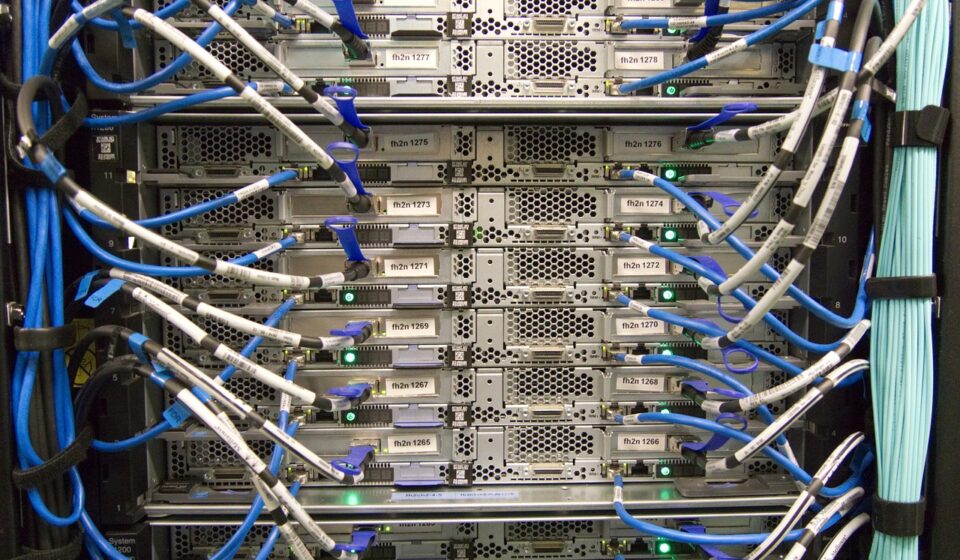

Fluidstack is a specialized AI compute infrastructure provider that builds and operates modular, high-performance data centers designed to deliver dedicated GPU capacity to leading artificial intelligence labs. By securing power agreements, real estate, and hardware supply chains in advance, Fluidstack compresses custom data center deployment timelines from 18–24 months down to six months.

What is Fluidstack and what does it build?
Fluidstack builds and operates the physical and logical infrastructure required to train and run massive artificial intelligence models. Rather than operating as a general-purpose public cloud with millions of small virtual machines, Fluidstack constructs specialized AI factories. These facilities house tens of thousands of high-performance GPUs connected by high-bandwidth network fabrics and supported by heavy-duty power and liquid cooling systems.
The demand for artificial intelligence compute has created a severe bottleneck for technology companies. Frontier foundation models require massive clusters of GPUs working in parallel. Obtaining those clusters through conventional infrastructure channels often takes two years because of power utility delays, facility construction, and hardware lead times. Fluidstack focuses entirely on eliminating this wait time by pre-assembling all physical components of the compute supply chain.
Originally founded as a British technology startup, Fluidstack transitioned into an infrastructure operator capable of deploying gigawatt-scale data center capacity. To support its international operations and stay close to major financial partners and enterprise clients, the company relocated its global headquarters to New York City in December 2025.
How does Fluidstack build data centers in six months?
Traditional data center development follows a sequential model: acquire land, apply for grid power interconnects, design custom buildings, complete civil construction, install cooling and electrical distribution, and finally rack the hardware. This chain of dependencies frequently stretches project timelines to 24 months. Fluidstack bypasses these delays through a parallelized infrastructure deployment strategy.
- Modular data center designs: Instead of constructing bespoke brick-and-mortar facilities, Fluidstack utilizes pre-engineered modular units. These units arrive on site with standardized rack configurations, cooling manifolds, and power delivery paths already built and tested.
- Strategic land and power banking: Fluidstack secures power purchase agreements and real estate leases long before a customer signs a specific compute contract. For example, a property transaction linked to the firm involved a 1.1 million square-foot lease in West Valley in June 2026, creating immediate capacity for future infrastructure deployment.
- Pre-committed hardware supply chains: By placing advance orders for transformers, high-density switchgear, fluid chillers, and GPUs, Fluidstack eliminates component lead times that stop standard construction projects.
- Parallel site construction: Civil site preparation, power substation hookups, and modular installation occur simultaneously rather than sequentially.
This streamlined approach allows artificial intelligence labs to scale up cluster size rapidly, turning infrastructure from a multi-year capital project into a predictable deployment schedule. If you want to understand how hardware configurations affect training performance, see Ccna Training: Your Essential Guide to Network Certification for an in-depth breakdown of cluster networking topologies.
How does Fluidstack compare with other compute options?
The cloud market has split into traditional hyperscalers and specialized neocloud operators. Choosing the right partner depends on whether an organization needs flexible, multi-tenant software tools or dedicated, gigawatt-scale hardware blocks.
| Provider Category | Primary Focus | Deployment Speed | Infrastructure Approach | Best Suited For |
|---|---|---|---|---|
| Fluidstack | Gigawatt-scale physical data center builds and GPU clusters | ~6 months | Modular physical builds, pre-banked power, turn-key delivery | Frontier AI labs needing dedicated, large-scale training clusters |
| CoreWeave | Specialized GPU cloud hosting and orchestration layers | Varies by region | Data center leasing and proprietary software management | |
| Lambda | On-demand GPU cloud and workstation hardware | On-demand / months | Colocation facilities and dedicated cloud instances | AI research teams, developers, and mid-sized model training |
| Hyperscalers (AWS / GCP / Azure) | General-purpose multi-tenant cloud services and enterprise SaaS | Instant (virtual) / long for custom clusters | Massive global cloud data centers with broad API suites | General enterprise IT, microservices, and standard web applications |
While hyperscalers excel at providing thousands of integrated software services for general web applications, their physical cluster lead times for massive GPU deployments can be slow. Neocloud providers like CoreWeave and Lambda offer specialized software and instances for GPU access. Fluidstack distinguishes itself by acting as a physical build-out engine, constructing and delivering massive dedicated facilities directly to hyperscale buyers and foundation model creators.
What major partnerships are driving Fluidstack’s growth?
Fluidstack has solidified its position in the AI infrastructure sector by securing several multi-billion-dollar infrastructure contracts.
An important partnership is with artificial intelligence research firm Anthropic. Fluidstack is managing the physical deployment of Anthropic’s $50 billion compute expansion, representing one of the largest technology infrastructure projects in United States history. This project involves procuring land, securing high-voltage power grid access, and building dedicated facilities to house Anthropic’s next generation of foundation models.
To secure the required power and hosting footprints, Fluidstack collaborates with digital asset and compute infrastructure firms. In May 2026, Hut 8 entered into a 245MW capacity agreement with Fluidstack as part of the broader multi-gigawatt build-out for Anthropic. This deal demonstrates how energy-heavy digital asset infrastructure can be converted to high-performance AI compute.
In addition to domestic expansion, Fluidstack has negotiated international capacity projects. During the AI Action Summit in Paris in February 2026, Fluidstack secured an $11 billion AI factory deal to establish high-density compute capacity across Europe.

What is Fluidstack’s valuation and funding history?
Fluidstack’s funding path reflects the high demand for dedicated artificial intelligence compute capacity. The market value of specialized infrastructure providers has climbed rapidly as foundation model developers compete for power and hardware availability.
In early 2026, Fluidstack sought $700 million in capital at a $7 billion valuation. Driven by massive commercial contracts and rapid deployment demand, TechCrunch reported these figures showing Fluidstack in negotiations for a $1 billion investment round at an $18 billion valuation by April 2026. This fast valuation growth follows an earlier milestone of $7.5 billion, marking one of the fastest capital expansions among European-founded technology startups, as highlighted by Forbes.
This capital supports upfront power site acquisitions, transformer procurement, and modular manufacturing contracts required to sustain six-month facility rollouts.
What engineering challenges affect rapid AI data center expansion?
Deploying massive compute facilities under compressed schedules introduces significant operational and engineering risks. The physical limitations of power grids, thermal management, and global supply chains create ongoing hurdles for operators.
Power grid interconnect delays
Securing hundreds of megawatts of continuous electric power is the primary barrier to expanding artificial intelligence capacity. Regional power grids face multi-year queues for transformer hookups and substation upgrades. As Schneider Electric highlighted in June 2026, power grid constraints remain a primary operational threat to data center scaling globally. Fluidstack mitigates this by identifying locations with existing industrial electrical capacity or co-locating near high-capacity power production sites.
Thermal management and liquid cooling
Modern high-density server racks generate extreme heat, often exceeding 100 kilowatts per rack. Traditional air cooling cannot dissipate this thermal load efficiently. Fluidstack utilizes direct-to-chip liquid cooling systems and rear-door heat exchangers. Maintaining closed-loop coolant chemistry and preventing leaks in facilities housing tens of thousands of liquid-cooled GPUs requires precise mechanical engineering.
Global component supply shortages
Even when land and power are available, supply chain bottlenecks can stall construction. High-voltage transformers, switchgear, liquid chillers, and optical networking optics frequently carry extended lead times. Industry analysis indicates that nearly half of planned U.S. data center developments experience delays or structural changes due to supply shortages. Fluidstack addresses this risk by buying hardware in bulk standard designs rather than relying on custom component ordering for every site.
What career opportunities exist at Fluidstack?
As Fluidstack expands its global footprint, the company recruits technical specialists capable of designing, building, and operating physical infrastructure at scale.
Key technical disciplines inside Fluidstack include:
- High-voltage electrical engineers: Responsible for power substation design, grid interconnect planning, and facility power distribution.
- Thermal and mechanical engineers: Focused on liquid cooling loop architectures, heat exchanger design, and fluid dynamics within high-density server racks.
- Network architects: Designing ultra-low-latency InfiniBand and Ethernet fabrics connecting tens of thousands of GPUs across data center halls.
- Data center operations managers: Overseeing physical site installation, equipment testing, and daily facility maintenance.
- Software engineers: Building infrastructure management software, telemetry monitoring, and automated cluster provisioning systems.
Compensation at Fluidstack is competitive with major technology firms and infrastructure operators. Data from LinkedIn indicates that compensation packages for specialized engineering roles range from $150,000 to over $300,000 annually as of June 2026, depending on location, discipline, and technical seniority. If you are preparing for infrastructure engineering interviews, see Artificial Intelligence: Navigating the AI Revolution for insights into system design expectations.
What are the common misconceptions about neocloud infrastructure?
Because neocloud operators grew rapidly during the artificial intelligence expansion, several misconceptions exist regarding their services and business models.
Misconception 1: Fluidstack is simply a reseller of public cloud instances
Fluidstack is not a software reseller or lightweight cloud broker. While early neocloud concepts involved aggregating idle server space, Fluidstack operates as a primary infrastructure provider. The company acquires land leases, secures direct grid power interconnects, orders modular hardware, and builds dedicated physical facilities tailored for massive AI training operations.
Misconception 2: Compressed build timelines reduce facility quality
A six-month build schedule does not mean skipping engineering safety or thermal standards. The speed advantage comes from standardization and parallel execution. By using pre-engineered, modular power and liquid-cooling blocks manufactured in controlled factory settings, Fluidstack avoids the weather delays, field design modifications, and custom construction errors common in traditional site builds.
Frequently asked questions
What makes Fluidstack different from traditional cloud providers for AI?
Fluidstack specializes in building and operating dedicated physical data centers and large-scale GPU clusters rather than managing multi-tenant public cloud software suites. Their entire process is optimized to deliver dedicated physical compute capacity in six months rather than relying on multi-year custom build schedules.
How quickly can Fluidstack deploy new compute capacity?
Fluidstack can deploy gigawatt-scale data center facilities in approximately six months. This compressed timeline is achieved using prefabricated modular building blocks, pre-banked power agreements, and pre-allocated hardware supply chains.
What is Fluidstack’s role in the Anthropic partnership?
Fluidstack acts as the primary infrastructure developer for Anthropic’s $50 billion compute expansion. This involves procuring real estate, securing high-voltage utility power agreements, constructing modular physical data center buildings, and deploying high-performance GPU clusters.
What is Fluidstack’s current valuation as of 2026?
Fluidstack reached an estimated valuation of $18 billion in April 2026 following discussions for a $1 billion funding round. This milestone followed an earlier valuation of $7.5 billion achieved earlier in the year.
Are there career opportunities at Fluidstack?
Fluidstack hires high-voltage power specialists, thermal liquid-cooling engineers, network architects, and facility operations managers. Compensation for technical engineering positions ranges from $150,000 to over $300,000 annually as of June 2026.
What challenges does Fluidstack face in the current market?
The primary hurdles facing Fluidstack include power grid interconnect queues, liquid-cooling maintenance at scale, and global supply chain lead times for high-voltage transformers and optical switches. Navigating these constraints requires long-term power banking and standardized modular procurement strategies.